Showing posts with label neuroscience. Show all posts

Thursday, July 1, 2010

Neuroscience Survey


Next quarter I will be a 4th year neuroscience major at UCLA.
Thinking I will soon be finished with my bachelor degree is at the same time exciting and a little scary.

During my time here at UCLA, I have really enjoyed my neuroscience and biological psychology classes. While the study hours are long, the material covered is really interesting.

Thinking about my place as a "Neuroscientist," I would like to know how I can help people with the knowledge that I've gained. I have only one year left here at UCLA, and I would really like to use that time to focus more on what I can give back to people after I graduate, more than one what I can gain for my personal satisfaction (which I have done for the past three years).


I would like to know what questions you would like answered. If you could ask a neuroscientist any question, what would it be?

I would really appreciate it if you could take this survey: Neuroscience Survey

Thank you !!! :-)

Sunday, May 2, 2010

Circadian Rhythms: Sleep at Night


So, You took the plane, you arrived at destination, but your body is not quite adjusted to the local time yet. The first 2 days after arrival you felt pretty good about yourself, because even though you didn't sleep the whole night, you still felt like you were ok. But now it's the 3rd or 4th day,..... and you're really tired, feeling kinda blue, and you just can't seem to sleep enough!

What can you do to fall asleep and wake up at the appropriate time???

Let's go back to your biological clock. Like I said in a previous post, your biological clock regulates your metabolism (when to sleep, when to wake up, when to eat, when to realease testosterone, cortisol, melatonin.....) and it has a feedback mechanism from the environment. Which means that if the sunrise and sunset rhythms change, step-by-step your body is going to adjust. In the same manner, if your eating pattern changes, step-by-step your body is going to adjust its internal clock.

The following is a number of tricks you can do to help your body adjust more quickly:

1. In the morning, around 7 or 8 am, get out of bed, open the curtains and sit in the sun (or in a bright place with natural sunlight) for about 30 min. This should start your biological clock, stop the release of melatonin (the sleep hormone) and push your body to get ready for the day.

2. Make sure your body warms up during this time. (That's why sitting in the sun is a good idea). Usually, the body warms up at the end of the night. A rapid increase in body temperature (of about 1 degree celcius, or 1.8 fahrenheight), through biofeedback, will "tell" your brain that its time to wake up.

3. After the 30 min, eat what you usually have for breakfast. (For those who don't usually eat breakfast, still force yourself to eat something).
Try to eat what you usually have as, through habit, it has become cues for your body about breakfast and what time of the day it is supposed to be. ("new" foods do not carry the same meaning. They could be a snack, lunch, dinner, ... your body does not know).

4. Follow the local time for the rest of the day.

5. At night, eat your last meal at least 2 hours before sleeping. Digestion results in an increase in body temperature which can hinder the release of melatonin--the sleep hormone.

6. 1 hour before sleep time, take a warm shower or bath. There are two reasons for this. The first one is that a warm bath will relax your mind, and release some tension in your body. The second one is that after you leave the bathroom, your body will experience a sudden decrease in temperature. This will signal the brain to start releasing melatonin.

7. 10 min before sleep time, lightly stretch your fingers and toes for 5 min. Lightly stretching them results in more blood being sent to the extremities, where the blood will cool down more quickly, and lower your body temperature even more. As you might have guessed by now, being able to lower your body temperature by about 1 degree celcius (1.8 fahrenheight) is key here.

8. This is also a good time to take a sublingual form of melatonin supplement if you need it. The sublingual form works much faster and much better than any other form as the particles disolve under the tongue and get taken up by the blood stream right away.

9. Sleep :-)

Repeat these steps everyday, and it should speed up your adaptation time. Or general sleep if you have a trouble falling asleep in genereal.

Here are some of the sublingual Melatonin products I recommend. (Please consult with a physician if necessary).

Saturday, May 1, 2010

Circadian Rhythms: How to overcome Jet Lag


Besides from a medical or psychological interest in circadian rhythms, another good application of the knowledge goes to overcoming jet lag.
(The plane picture comes from here.)

Let's say you travel to a place which has a time lag of an hour or more with where you live. You will probably experience jet lag. A set of syndromes from an inability to fall asleep or wake up when it's appropriate to fatigue, a blue mood, and a slight loss of memory.

To readjust your body clock to the new time, it takes on average one day per hour of time lag. So, if there is only one hour or two of time lag, it is probably not such a big deal. Your body will adjust itself in a day or two.

If, however, the time lag is of 5 hours, 10 hours or more, a full week or more without adequate sleep can take a toll on your body, and not be such a pleasant experience. (Specially if your vacation only lasts a week, and you have to go back after 7 days.... another week to get readjusted --> that gives at least 2 weeks without adequate sleep!)

What can you do to speed up the process??
There are two mechanisms that control your circadian rhythm: sunlight and food.
Here, I am only give you a step-by-step procedure. (If you are interested in how sunlight and food act together in controlling the body's biological clock, read the next article I am going to post.)

1. Some people recommend "getting used" to the new time before you take the plane. This is probably a bad idea! You are just going to make your body more tired and mess up you sleep pattern earlier than it should be. No, before your trip make sure you sleep well and are well relaxed and full of energy. You want to be able to be as healthy as possible on arrival.

2. This might be the hardest part, specially if you are on a 12 hour flight or more, but it is the most important! I'm serious. Do Not Eat Anything in the Plane!! The hunger and fast will kinda "reset your biological clock to 0." Afterwards, your "eating" clock will adjust to the time of the first meal you take.

3. If you can sleep in the plane, great! If you can't, just close your eyes and try to "keep in the dark." We also want the "sunlight clock" to be reset to 0.

4. Drink more water than usual in the plane. There is inherent stress with traveling, and the AC environment is pretty dry. So just drink plenty of water to keep yourself hydrated, and help your body get read of the stress' toxicity.

5. When you arrive at destination, follow the local rhythm right away. Do not sleep if it is day time, and only eat your first meal at the right time. (but don't eat breakfast if it's the afternoon, or vice versa. Eat a "real," full, local time, meal.)

6. If you really can't stay awake, take a 15~20 min nap... as many as you need, but make sure to stay awake at least one hour and a half between each nap.


This is for the "travel time" part of adjusting to jet lag. If you are still having some problems falling asleep at night, there are some other tricks you can do. Please come back to this blog and read the following posts.

Thursday, April 29, 2010

Circadian Rhythms

In humans, circadian rhythms are set to about 24.5 hours. The circadian rhythm is the internal clock that regulates the body's metabolism. If some people are left in a completely dark basement for a week, they will wake up each morning about half an hour later. (For some people this is what happens during the week end).

How does the circadian rhythm work?
In a very simplified schema, this is what happens:
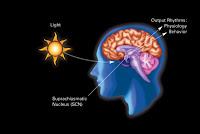
The biological clock is reset every morning at dawn by having sunlight excite a system of cells responsive to light: the photosensitive ganglion cells. These cells are different from the rodes or cones used in vision, as with them you wouldn't be able to see anything. (image)

Once the photosensitive ganglion cells are activated they send electrical impulses via the use of melanopsin, to a part of the brain, the suprachiasmatic nucleus (in the hyppothalamus), who's role is to regulate hormone secretions in the body.

Now, at a genetic level, in the morning a set of genes are expressed, forming diamers (two molecules working together) in the cytoplasm. At night, those same diamers go back in the nucleus and turn off the transcription process. (For a more scientific article on a sleep disorder related to gene transcription look here).

I believe that more research on circadian rhtythms in humans might lead to a big improvements of health (by restoring healthy metabolism) and mood disorders.

There is another very interesting blog on the subject: look here.

Tuesday, April 27, 2010

UCLA Circadian Rhythm Research

Today I listened to a presentation given by Professor Colwell of UCLA about his research on circadian rhythms.

Circadian rhythms are really interesting as they affect every cell of the body. They affect your metabolism, general health, mood.....

What I found particularly interesting was the fact that disruption of circadian rhythms, in mice for example, can induce type II diabetes, mood disorders, cardiovascular diseases, memory loss (on humans, the subjects can learn, but not remember afterwards), and cancers (predominantly breast cancer).

When looking at mood disorders or neurological disorders, one of the first symptom that bothers patients is the inability to sleep regularly. In the case of Parkinson's disease for example, sleep disorders occur up to 15 years before other symptoms. One of Dr. Coldwell theories relates to whether treating circadian rhythms could offset the appearance of other symptoms of Parkinson's.

As a side note, other labs are conducting research on how night shifts affect nurses, and the prevalence of cancers.

Dr. Coldwell is a faculty at the UCLA school of medicine in the department of psychiatry.
he is currently conducting research on circadian rhythms.